
Notice the Earth Atmosphere on Blue Marble.
The Greenhouse Gases in the atmosphere, that have become the bogeyman of our times, seems they are 
But let we see in some detail what are the Greenhouse Gas and how to fight them.
Greenhouse gases are atmospheric gases that absorb infrared radiation causing the greenhouse effect. Natural greenhouse gases include the vapor of water, carbon dioxide, methane, nitric oxide and ozone. Certain activities, however, raise the level of these gases and other gases in the release of greenhouse exclusively anthropogenic origin.
The water vapor is present in the atmosphere as a result of evaporation from all water sources (seas, rivers, lakes, etc..) and as a product of various combustion. Carbon dioxide is mainly released into the atmosphere when solid waste is burned, fossil fuels (oil, gasoline, natural gas and coal), wood and wood products. Methane is emitted during the production and transport of coal, natural gas and mineral oil.
If you look at data on the presence of Greenhouse Gases in the atmosphere during the last 300 years have seen a dramatic increase since the Industrial Revolution onwards, the correlation between industrialization and Greenhouse Gases in the atmosphere is really evident.
As we could fight the presence of Greenhouse Gases in the atmosphere? Mainly those starting to limit human activities that generate greenhouse gases through the use of Renewable Sources of Energy and by Energy Saving.
Look at this Video discussing the importance of both targeted actions to reduce emissions and partnership opportunities between developed and developing state and provincial governments. Targeted actions can take the form of technology transfer, best practices sharing, and market-based approaches to reducing emissions or other actions that provide mutually beneficial outcomes.
"Nuclear? There is no prejudice in technology, but - as is planned - I feel more a mirror for birds. For at least three good reasons, if not removed, everything would be read as improvisation "said Giacomo Berni, national secretary of Filcem - the Federation of Workers of chemistry, energy and manufacturing of Cgil - at the opening of the congress' Energy constraints, choices, opportunities", held today in Rome at Palazzo Marini. The first. The claims that more than 20 years ago 'we brought to referendum (catastrophic risk, waste storage) are today - said Berni - still valid': Italy then instead maintain - as is required by law - a 'garrison Research has abandoned this technology and, if we exclude the activities of disposal sites conducted by Sogin (of which are being asked inexplicably - adds Berni - the dismemberment and the Commissioner), did not produce absolutely nothing.
The second. Through a lot of ease, in the "energy package" contained in the draft law 'development' linked to the financial maneuver "is expected - continued the Secretary - the creation of an Agency for Nuclear Safety too centralist, with powers as binding to represent a force against the involvement of local authorities, contradicting the need for neutrality and transparency of their authority should be required to provide guarantees to citizens on an issue which - needless to say - raises concern. "
The third. As to the thorny problem of costs, balances in hand, a third generation plant from 1600 Mw would cost 5 billion euros per section, including the cost of "decommissioning" which can no longer be called into account the state. The same length of the stage feasible of equipment (estimated at 8 years plus 2 procedures) determines - supports the Filcem-Cgil - uncertainty on the timing of return of bank finance, as well as the protracted time depreciation of equipment (at least 20 years) over time diluting any benefits for consumers.
The Filcem-Cgil instead launches a proposal: 'Why - Berni claims - do not concentrate in the short to medium term in the realization of photovoltaic and wind power plants that would benefit the country in the European targets, reducing the price of oil? " . The figures speak for the photovoltaic there are already 137 requests for parks, with a peak power for 2740 Mw; for wind power, for 1023 parks for a total power of 61,380 MW.
'And' realistic course - Berni suggests, borrowing an estimate made by a group of experts from the associations of consumers and producers of conventional - the creation within 3-5 years of 1.200-1.800 Mw photovoltaic and wind power 15.000-20.000 Mw (third the installed capacity).
These proposals useful for the country to break its dependence on "all oil" and "all gas", to achieve the objectives of Europe'20, 20, 20 'and the urgent need for a strategy of diversification of energy sources. "We have title to advance - continued Berni - precisely because we have strong support to the process of opening the energy market - still unfinished - and supported choices in support of" clean coal ", the gasification and the thermo ', so we facilitate reducing the cost of importing raw materials from which the country is known, does not have the energy bill is still very high: 46.6 billion euros a year (3% of GDP) with 57 % Of spending to buy oil!
"But today - questions the union leader - in the light of the financial tsunami, how can mitigate rising energy costs and impact on business and income of workers?". Two - the second-Cgil Filcem - the recipes are possible: 1) increasing efficiency and saving energy, both, are an essential instrument of government demand and stimulating investment in sectors such as solar, wind, the termoelettromeccanica, the chemical, construction, transport, and 2) to assess the possibility of cutting the tax on petroleum products, now well above 40% of their final cost. The objective of significant reduction of excise duty on fuel - concluded Berni - would be more effective suppression and healthy part of the purchasing power of wages for workers.
It comes from Spain, where since 2003, a new form of investment linked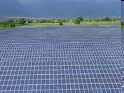 to renewable energy, which could in a moment of difficulty in financial markets as the present one, represent a cornerstone for the many savers who do not really know what direction taken and especially of those who trust. They are called "Huertos solares" and were created by Acciona, a company leader in photovoltaic and wind power in Spain.
The concept is very simple and is identified in the possibility of sharing it among several investors units of a large photovoltaic system, so managing to kill one of the major impediments, so far, development of the sector, which is still higher than the costs installations and their goodwill. Every single investor instead in this way, with a relatively modest supply of money, could enjoy the benefits of generous incentives promoted by Consolidated Energy for 20 years and then decide what to do after the expiration of the incentive period.
Acciona in Spain has already deployed 12 "solar gardens" for a capacity of over 25 MW of power. The largest has a capacity of nearly 10 Mw and about 750 owners who have paid around 50,000 euros to get a slice of the great facility and enjoy the economic benefits of generous incentive plan Spanish. Overall project Spaniards joined around 2200 investors who bought shares for a total of 177 million euros. According to calculations made by specialists of the money invested was written off in about 3-4 years, and the average income of a solar share is around intron 8 to 10% annually.
In our country, which is still behind the Spanish country in the development of renewable energy resources, timeshare this form of the sun has not yet made its appearance if not at trial, as is the case of photovoltaic condominium project, led forward in 2006 by the Department of Industrial Chemistry, University of Bologna: in short, promote and organize the ownership of a photovoltaic 300 KWp on a roof of a joint industrial belt town of Bologna.
Or something like that is contained in the draft Heliantide construction of the farm in Calabria, which will be equipped with solar photovoltaic power to chase with a capacity of over 350 kWp and manufacturability awaiting 676,052 kWh per year. Heliantide will therefore be the destination for investment by those who are interested in buying shares is that the power of timeshare photovoltaic of residential villas. It is a package amounting to 4,499,000 euros divided into two parts: one for those targeted to invest in solar photovoltaic central KWp from 352.8, and the other for those facing the purchase of timeshare facility integrated into the structures and of residential villas.
But certain is that in our country yet there is nothing organized as in Spain. The idea that some might even grow businesses that could create real "photovoltaic districts, consortium and buying portions of a large central photovoltaic that could be used to supply power to enterprises and is to get the incentives from the State on energy not consumed locally.


Copyrights @ RoxBlog Trends - Blogger Templates By Templateism | Templatelib