Top Ad 728x90

Showing posts with label science. Show all posts

Saturday, December 15, 2012

The Diamond Planet 55 Cancri e

by

The surface of 55 Cancers e, composed largely of graphite, is surrounded by a thick layer of diamond.


The universe is a bit 'more "rich" thanks to the discovery of the chemical composition of a planet located in a nearby constellation: it is made almost entirely of diamond.

This rocky planet, named 55 Cancri e, is large only twice the Earth but eight times the mass of our planet, characteristics which, according to a new study, making it a so-called "super Earth." This planet, observed for the first time in 2011 in front of its parent star, it takes only 18 hours to complete an orbit around its star. Consequently, the surface temperatures, which can reach 2150 ° C (conditions that make the planet uninhabitable) and carbon, create ideal conditions for the formation of diamonds.

Thursday, November 1, 2012

The Story of Earth

by
The Story of Earth
The Story of Earth starts 5 billion years ago when the Sun was formed from Cosmic dust and all the Planets including Earth started to be formed from orbiting residues.

Crash after crash between meteorites the first Earth shape has been formed.

The Earth might seem solid beneath our feet but five billion years ago there was no sign of the planet we call Earth. Instead there was only a new star and a cloud of dust in our solar system. Over millions of years, a series of violent changes led to the formation of our world and, eventually, the creation of life.

Sunday, July 8, 2012

Higgs Boson CERN discovery.

by
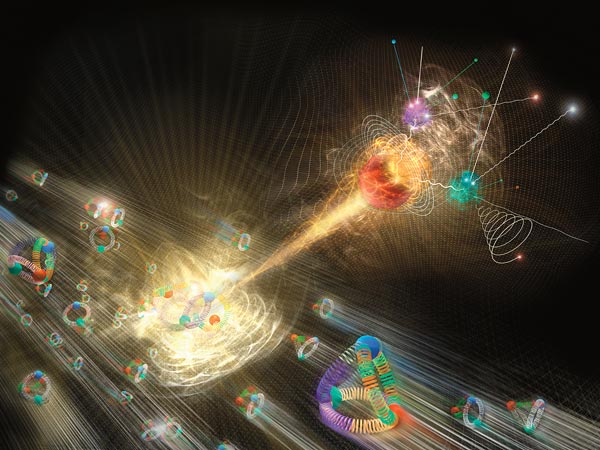
The Higgs mechanism had to wait 48 years to be confirmed. Finally during CERN experiment a new particle has been discovered likely to be the Higgs Boson, the so called GOD PARTICLE, responsible to give the Mass to the other particles.

The following VIDEOs illustrates how Higgs Mechanism works and what makes the Higgs Particle so special. 

This is a great achievement in the understanding of how our Universe works.

Wednesday, February 22, 2012

Einstein's Special Relativity is safe. Measurements on the Speed of Neutrinos are Incorrect

by
Measurements performed at CERN - GRAN SASSO ​​on the speed of neutrinos appear to be incorrect. The anomaly revealed during the experiment that took place on September 2011 seemed to uncover a revolution in physics and a violation of Einstein's special relativity. But that anomaly appears to be due simply to a failure of communication between a GPS device and the computer responsible for the registration of measured events.

It is a rude awakening for those who carried out the experiments and hoped to found a violation in the most simple and elegant theory ever devised by human mankind (Einstein's special relativity), but surely a relief for a generation of theoretical and experimental physicists who have spent a lifetime in studying based on the knowledge acquired by the theory of Einstein.

As I reported in various posts (eg see here) it is very likely that the laws of special relativity should be generalized to very high energies up to embrace a new universal constant, the Planck length, exactly in the same way the velocity of light c is. This deviation allows superluminar velocity for particles with very high energy. But clearly the conditions of the experiments performed at CERN-Gran Sasso have not the peculiarities nor the energy to unveil a deviation from Einstein's Special Relativity.

For who do not know about Einstein Theory here it is Special Relativity explained in 5 minutes.


Sunday, February 19, 2012

The Higgs Boson - Illustrative Video

by
The Higgs Boson has been searched and is still searched in several large experimental groups. The Higgs boson is the elusive subatomic particle which is thought to explain the origins of particle mass, but no one experiment has been able to find it.

The video illustrates what the Higgs Boson is.


Saturday, November 26, 2011

Neutrinos Faster Than Speed of Light?

by
Since Einstein stated than c, the speed of light in vacuum, is a universal constant in nature, several experiments have been made confirming this assumption. Recently Scientists in Switzerland say an experiment appears to show that tiny particles traveled faster than the speed of light -- a result that would seem to defy the laws of nature. The physicists say that neutrinos sent 730 kilometers (453.6 miles) underground between laboratories in Switzerland and Italy arrived a fraction of a second sooner than they should have, according to the speed of light.

The physicists say the measurements of the distance and the time involved were performed with great precision, to nanosecond accuracy. And the results seemed to show the neutrinos travel "at a velocity 20 parts per million above the speed of light, nature's cosmic speed limit."

Sunday, May 22, 2011

Gliese 581d The New Earth 20 Light Years Far

by
Gliese 581d is a new extra Solar System Earth-like Planet discovered by Cnrs, the French Center For National Research. It orbits around Gliese 581 Star, without "d", at a distance right inside the Goldilock zone. The Goldilock zone is a zone around a star that allow the presence of Liquid Water. Its surface temperature is not so hot nor so cold to make Water respectively to evaporate or freeze. As anybody knows the presence of liquid Water on a planet is essential to develop Life. Almost in the form we know Life.

Gliese 581d has also a high density of CO2 in its atmospheare. It is likely, therefore, the presence of life in form of plant other than animal. Gliese is then a good candidate to be hosted by life.

Anyway Gliese 581d could appear a strange World if visited by Humans. The denser atmosphere and gravity twice that of Earth could make the new Earth a World different from our Planet.

The denser atmosphere absorbs light more than on Earth. If observed by Gliese surface therefore the sky will appear with a permanent red-sunset-like color. While the higher gravity would make all heavier. About twice.

With present technology it is almost impossible to arrive on Gliese 581d. It would take 20 years traveling at the speed of light, or 300,000 year with ours spaceships!

The following videos shows what we known about the Gliese "Solar" System.


Sunday, May 15, 2011

The Uncertainty Principle of Quantum Mechanics

by
The Uncertainty Principle is one of the fundamental laws at the base of Quantum Mechanics. It was postulated by Heisenberg and states precise inequalities that constrain certain pairs of physical properties, such as measuring the present position while determining future momentum.

It introduces also a precise relationship between space, momentum and the Planck constant ħ.


The following video introduces in a simple way the Uncertainty Principle. Enjoy yourself on Fair Science!


Video. The Uncertainty Principle in Quantum Mechanics


The Stern Gerlach Experiment Reveals The Quantum Nature of Matter

by
With the Stern-Gerlach experiment I started a series of posts where I want to describe in simple terms the quantum nature of reality that surrounds us. The experiment of Stern Gerlach experiment is particularly important because it is not directly understandable in terms of classical mechanics.

In quantum mechanics, the Stern–Gerlach experiment, named after Otto Stern and Walther Gerlach, is an important 1922 experiment on the deflection of particles, often used to illustrate basic principles of quantum mechanics. It can be used to demonstrate that electrons and atoms have intrinsically quantum properties, and how measurement in quantum mechanics affects the system being measured.

Here I present a very explanatory video that allows us to understand what are the differences between the quantum and the macroscopic world described by classical mechanics.

The Double Slit Experiment

by
The double-slit experiment is a variant of Young's experiment that allows to demonstrate the wave-particle duality of light and matter. Richard Feynman used to say that the heart of quantum mechanics can be understood by reflecting on this experiment.

Quantum Mechanics says that makes no sense to ask a priori the question about what "really" a quantum object is. This is the meaning of the superposition principle which states that wave and particle are just categories of our language by which we describe what we observe in a quantum experiment. Only the experiment shows us the wave or particle nature.

The next video shows the double-slit experiment in a fantastic and very descriptive way.


Friday, September 4, 2009

NASA releases detailed pictures of Mars

by
NASA has released thousands of high-resolution images of Mars, taken from the Mars Reconaissance Orbiter (MRO). They show a vast range of geographical features in detail, including craters, gullies and dunes, such as this crater near Ianis Chaos. The Mars Reconnaissance Orbiter has been studying Mars with an advanced set of instruments since 2006, and has returned more data about the planet than all other past and current missions to Mars combined, says NASA. The newly-released pictures form part of over 1,500 telescopic images recorded by the High Resolution Imaging Science Experiment (HiRISE) camera between April and early August. Each image covers a strip of Martian ground six kilometers (3.7 miles) wide and about 12 to 24km long, showing details as small as one meter, or yard, across.

More images are available here.

tgdaily.com

Thursday, July 23, 2009

NASA since Apollo: failures and successes

by


What has NASA done right since Apollo? Where has it erred? Are there other space programs in the world that perform certain functions better than NASA?

The two agencies within NASA
Were we to bring a citizen from the past -- an ancient Roman, a hunter-gatherer-scavenger or an early 20th century barnstormer pilot -- to the present and show her or him what NASA does, I should hope they would be very impressed -- blown away might be more like it. NASA does great things.

The question for us as modern citizens is this: Does NASA do what it does well enough? Could the missions and goals of the organization be better achieved by others, other governments or other private companies? The answer, roughly: It depends.

If you want to put a communications satellite in geosynchronous orbit, commercial companies probably have NASA beat.

If you want to put a spacecraft right down on another planet or in the path of a passing asteroid and get good data for years on end, NASA is pretty much the best in the world. Other agencies are good; NASA has just been at it longer (without interruption) than anyone else.

But if you want to get people up and back from low-Earth orbit, NASA right now has, by one reckoning, a 1.6% chance of killing your crew. Few among us would do any sort of travel with those odds. Dangerous as it remains, human space exploration inspires us.

NASA, it seems, has somehow become two agencies. One group advocates robotic exploration, sending spacecraft to watch the sky from above our air, and to Mars, Mercury, the moons of Jupiter and Saturn, even to icy Pluto. The other group wants to send humans into low-Earth orbit and go back to the moon -- using the English system of feet and gallons, with temperature measured in degrees Rankine. Sorry, that's not the stuff of the 21st century.

The space shuttle has proved to be an unreliable, expensive rig, hardly the easy-to-fly space bus we hoped for in the 1970s. It's been deadly for 14 people and deadly for NASA. The next system simply has to work better.

Scientists, who've spent time with this problem, point out that a robot can do in a day what a human scientist does in about a minute. When we use our robots to find a very, very likely spot to look for life on Mars, NASA's astronauts must be ready to explore like no one has done before. That sort of discovery would change this world, and will prove well worth the risk.

It's up to our new NASA administrator to calm the Cold Warriors and focus the agency on what it does best: inspiring us as we explore stars and worlds from space. As you read this, tiny plaques on the Spirit and Opportunity Mars exploration rovers await, glistening in the Martian sunlight, wishing those who visit there a safe journey and the joy of discovery. Here's hoping our new administrator can make it so.

Bill Nye hosted the Emmy-winning series "Bill Nye the Science Guy" on PBS from 1992 to 1998. He is a member of the board of directors and the vice president of the Planetary Society.

NASA trashed its own brand
In 1961, President Kennedy issued a dramatic challenge: "This nation should commit itself to achieve the goal, before the decade is out, of landing a man on the moon and returning him safely to the Earth." At the time he said this, many of the key technologies and techniques required to accomplish this astounding feat did not exist yet.

The famous science fiction writer Arthur C. Clarke said, "Any sufficiently advanced technology is indistinguishable from magic." When NASA did the seemingly impossible and pulled off the Apollo moon landings, astronauts became our brave heroes and NASA was viewed almost as an academy for wizards and alchemy.

Through the extraordinary results of key missions, NASA earned the solar-system equivalent of unparalleled "street credibility." This success fueled the emergence of the NASA "brand," one of the most recognizable and powerful franchises on the planet. When the public thought of NASA, it often thought of science, integrity, discovery, credibility, high technology and the future of humanity. NASA made being a techie nerd cool.

But in 1972, President Nixon shut down the Apollo program and approved the development of the space shuttle. As you point out, Bill, the shuttle "has proved to be an unreliable, expensive rig, hardly the easy-to-fly space bus we hoped for." Historically, this was probably the moment when NASA plans and strategy began to drift and the agency itself became "lost in space."

NASA's brand, once its greatest strength, became a major weakness. The Apollo battle cry of "failure is not an option" somehow gave way to a twisted bureaucratic mantra. The agency has become staunchly risk-averse, slow, inflexible and at times arrogant. Sadly, this transformation has not prevented failures but has actually facilitated them.

NASA has assembled perhaps the largest group of world-class talent on science and technology. But rather than inspiring its bright minds to excel, it has instead smothered them with bureaucracy.

All brands have life cycles. Importantly, an organization cannot manage its brands entirely by public relations and spin. Brand values have to be primarily driven by strategy and earned by results.

To enhance its space credibility, NASA needs to focus on what it does well. The agency has had some great success with space probes, rovers and basic research and development. NASA should transition itself out of as many operational activities as possible. Countries such as India and China are now able to accomplish a tremendous amount with much more modest investments than ours. These countries are also willing to take greater risks.

Most important, NASA has shown humankind the universe. Now let's go back.

Source: latimes.com

Saturday, July 18, 2009

To the moon and back: Apollo 11 success was quietly hatched in South Bay

by

Just eight years after a young president committed to "landing a man on the moon and returning him safely to Earth" by the end of the 1960s, Neil Armstrong took humanity's first step on a foreign world.
When Apollo 11 touched down on the lunar surface 40 years ago, it seemed that the whole technological miracle — thundering rockets, tiny computers, Velcro, Teflon and Tang — had bloomed between John F. Kennedy's 1961 speech and Armstrong's "one giant leap for mankind."
But it hadn't.
Scientific work, vital to the flight's success, had long been going on at an obscure research outpost in the valley. There, a few "wind tunnel jockeys" had quietly been working since the early 1950s on perhaps the most difficult problem of any moon mission — the part about returning safely to Earth.
The searing heat of hitting the atmosphere at 25,000 mph on the way back from the moon would melt or vaporize any known material that could be flown in space. It was the insight of engineers and scientists working at what would become NASA's Ames Research Center that a spacecraft shaped more like a bucket than a bullet could survive re-entry.

"The blunt-body concept, I think, was our major contribution to Mercury, Gemini and Apollo," said Jack Boyd, who arrived in 1947 to what was then the National Advisory Committee for Aeronautics' (NACA) Ames Research Center. Today, nearly 84, Boyd still clocks in a 5 a.m. every day as Ames' senior adviser to the center director and chief historian.
For those who remember being glued to the TV on July 20, 1969, when Armstrong and Edwin "Buzz" Aldrin walked on the moon, and for a beleaguered space agency hoping to recapture lunar glory, Monday's 40th anniversary of the first landing is a powerful historical beacon.
NASA was formed, incorporating Ames and NACA, in 1958. When Kennedy committed America to a do-or-die sprint with the Soviet Union to make sure "a banner of freedom" was planted on the moon instead of a Communist flag, life quickened at sleepy Moffett Field.
Suddenly, there was an influx of idealistic young scientists willing to work around the clock, secretaries with desk drawers stuffed with cash to instantly buy scientists whatever they needed, and powerful new instruments which sometimes exploded with enough force to saw buildings in half. Ideas soared. It was a dangerous and thrilling time.
Apollo's "major accomplishment was to show the world that democracy was a viable form of government," said Bill Borucki, a physicist who arrived at Ames in 1962 fresh from the University of Wisconsin to work on the critical Apollo heat shield. Today, at 70, Borucki is the lead scientist for Ames' recently launched Kepler probe to search for Earthlike planets circling other stars.
"At that time, a lot of people felt a centrally directed government — i.e., Russia — was the way to go. That was a vital argument back then, and countries were looking around back then and saying, 'Who do we follow?' " Borucki said. "We had to be the winner."
Turning point
Contrary to popular belief, Teflon and Velcro were not invented in the space program, although Nike "Air" cushioned basketball shoes and cordless drills feature Apollo technology. But beyond politics and new technology, Apollo brought other benefits.
The Apollo 8 photograph of the blue Earth, isolated and fragile in the vast emptiness of space as it rose over the desolate moon, helped crystallize the environmental movement, said Andrew Chaikin, author of "A Man on the Moon" and a major Apollo program historian.
The moon landing was "nothing less than a turning point in human evolution," Chaikin said. "We didn't go to the moon for the sake of experimentation; we went because we wanted to beat the Russians. But what we got as a bonus was a whole new perspective on ourselves."
For some Americans, it was a wasteful, expensive sideshow to real-world problems. Conspiracy theorists still claim the Apollo missions were staged by NASA — to the consternation of the surviving 10 astronauts who walked on the moon.
But the world literally stopped to look as Armstrong and Aldrin became the first two humans to land on the moon on July 20, while astronaut Michael Collins orbited above in the Apollo 11 command module. More than 500 million people watched on television as Armstrong was the first to step off the module's ladder. The photograph of Armstrong's first boot print in the lunar dust is an iconic image of human history.
"I think the cultural significance of Apollo is absolutely profound," Chaikin said. "I think we don't see it day to day because we live in such an information overload, 24/7 world."
Gumdrop shape
It might not have happened without the scientists at Ames.
As NASA prepared a plan to fly to the moon, "the concern at the time," said Borucki, "was we would get the astronauts safely to the moon, get them back and then they would burn up in the atmosphere."
The angle at which the returning spacecraft hit the Earth's atmosphere was critical. If it came in too shallow, the astronauts would bounce into outer space forever. And if it came in too steep, nothing but ashes would survive. Ames helped perfect that re-entry corridor.
But another insight was also critical: Ames scientists in the 1950s theorized that a blunt-faced spacecraft would do better than a streamlined shape at allowing the craft's heat shield to work. The bottom of a gumdrop-shaped capsule, they discovered, would produce a shock wave of superheated gases away from the vehicle, channeling much of the heat away. The shield would have sufficient insulating properties to protect the astronauts from the heat that remained, as it gradually vaporized during re-entry.
To design an actual working spacecraft, Ames had to build test instruments that could produce airspeeds 30 times the speed of sound and heat materials to 4,000 degrees as in the temperature of re-entry.
Like Borucki and Boyd, many of those same powerful instruments are still at work helping to design the Orion spacecraft NASA hopes to send to the moon in the next decade.
One recent morning, outside an arc jet bristling with hoses that uses a powerful electric current to heat air to thousands of degrees for heat shield tests, Boyd showed Borucki a keepsake of the heat shields they worked on back in the '60s. There were pieces of the heat shields from John Glenn's first orbital capsule, from the Gemini capsule that carried Gus Grissom and Ed White to the first American spacewalk, and from an Apollo capsule.
Borucki remembers the crazy pace — and the freedom to take risks — that were so much a part of life at Ames between 1961 and 1969.
"We were running 24 hours a day. Congress was giving us all kinds of money. When we said, 'We've got a problem,' the answer from the top was, 'Buy it,' " he said. "I miss those days. We got an awful lot done."
One of those instruments, a hypersonic wind tunnel, exploded in the mid-1960s, shooting pebbles heated to 3,000 degrees with such force they shot through the walls and roof of the building, igniting cars parked outside. Luckily, no one was hurt. Still, the Apollo 1 fire during a routine test that killed astronauts Grissom, White and Roger Chaffee showed NASA was not always so lucky.
For Boyd, whose office is filled with photos of himself with everyone from H-bomb physicist Edward Teller to William Shatner and Armstrong, one lesson of Apollo was what people can do if organization, national will, money and talent come together.
"Some people have said the Apollo challenge was as much a management success as a technological success," Boyd said. "One hundred years from now, it will be perceived as one of the most important events of the century. It depended on our political will, and the money we had to go with it."

Fonte: mercurynews.com

Monday, July 13, 2009

Space shuttle tries again to launch

by
NASA will give the launch of the space shuttle Endeavour another try Monday, after having been repeatedly thwarted by the weather and technical malfunctions. Monday's attempt is scheduled for 6:51 p.m.

Weather forced the cancellation of launch attempts Saturday and Sunday. And last month, two launch attempts were scrubbed because of a hydrogen leak.

On Sunday, lightning and cumulus clouds violated guidelines in case of an emergency landing and sent astronauts back to their quarters for the night. Cumulus clouds are tied to volatile weather such as lightning and tornadoes.

On Friday, 11 lightning strikes hit within a half-mile of the launch pad, scratching Saturday's launch.

Endeavour, carrying seven astronauts and a key component for Japan's Kibo science laboratory, is to head to the International Space Station for a 16-day mission.

Five spacewalks are planned for the crew after the shuttle docks.

The Kibo science lab, also called the Japanese Experiment Module, is Japan's first human space facility, and has been more than 20 years in the making.

Source: cnn.com

Sunday, July 12, 2009

Picturing the unutterable beauty of space. The First Moon Landing Video

by

At a point several years ago when James Cameron was eyeing a civilian tagalong aboard a Russian space flight, his message to prospective backers came down to one key selling point. “Astronauts are remarkable people and good at their jobs,’’ Cameron was quoted as saying. “But unfortunately their job description does not include the poetry and passion necessary to convey to the earthbound what it means to live and work in space.’’ A new reissue of the documentary “For All Mankind’’ (1989), timed to mark the 40th anniversary of Apollo 11’s touchdown on the moon, both validates and contradicts that argument. The film was assembled by journalist-turned-filmmaker Al Reinert (“Apollo 13’’) from footage that was sitting largely ignored in NASA’s vaults, overlooked by staffers who ultimately had science, not photography, on the brain. “It was only accidentally that they got these beautiful images,’’ Reinert notes in a half-hour retrospective. Reinert lets the Apollo astronauts themselves relate the action, both through interview audio and original transmissions. Hearing one astronaut marvel that the sight of Earth from space is “out of this world’’ inadvertently makes Cameron’s case about articulating the experience. But Apollo 17’s Gene Cernan, the last man to set foot on the moon, makes clear that the astronauts understood they “just had to steal time now and then. [Bringing] back some kind of thought and feeling was as important as bringing another chunk of rock back.’’ (Criterion, $29.95; Blu-ray, $39.95).

Source: boston.com

The First Moon Landing Video


Wednesday, July 1, 2009

New class of black hole could explain cosmic leviathans

by

Astronomers on Wednesday said they had identified an intermediate class of black hole that could explain how supermassive, light-sucking monsters develop in the heart of galaxies. Their find -- a black hole more than 500 times the mass of the Sun, on the fringe of galaxy ESO 243-249 -- is reported in the latest issue of Nature, the British-based science journal. In terms of size, it lies between supermassive black holes, which can be billions of times the mass of the Sun, and relative tiddlers, which are between three and 20 solar masses.
Black holes are among the most powerful forces in the Universe. They are concentrated fields of gravity which are so powerful that nothing, not even light, can escape them.
Stellar-mass black holes are believed to have been created from the death throes of massive stars.
But there is less consensus over how supermassive black holes, which lurk in the centre of galaxies, including the Milky Way, are formed.

"One theory is supermassive black holes may be formed by the merger of a number of intermediate-mass black holes," said lead author Sean Farrell, an astrophysicist at Britain's University of Leicester.
"To ratify such a theory, however, you must first prove the existence of intermediate black holes."
As black holes do not emit light, the existence and size of the intermediate black hole was detected thanks to its "ultra-luminous" X-ray emissions, spotted by Europe's XMM-Newton orbital telescope.

PARIS (AFP)

Thursday, June 18, 2009

US lunar probes set to blast off

by

Nasa is set to launch two spacecraft to the Moon in preparation for a return to the lunar surface by US astronauts. LRO (Lunar Reconnaissance Orbiter) and a crater observation mission will lift off from Florida on an Atlas V rocket. Data gathered by LRO will help mission planners select future landing sites and scout locations for lunar outposts. The second mission will send a rocket stage crashing into the lunar surface to scour the resulting debris plume for evidence of water ice. The Atlas rocket, carrying both payloads, is scheduled to blast off from Florida's Cape Canaveral Air Force Station at 2212 BST (1712 local time) on Thursday.
LRO will enter a low polar orbit around the Moon at an altitude of around 50km (31 miles) - the closest any spacecraft has continually orbited Earth's natural satellite.
It will map the lunar surface in unprecedented detail and is expected to enhance our understanding of the Moon's topography, mineral composition and lighting conditions.
The mission will also seek to characterise the Moon's radiation environment, helping mission planners assess the risks posed to astronauts.
The second mission, the Lunar Crater Observation and Sensing Satellite (LCROSS), aims to answer whether there is water on the Moon - either in the form of ice or hydrated minerals. It consists of two elements: a shepherding spacecraft and a Centaur upper stage rocket.

After being guided to a permanently shadowed crater at the Moon's south pole by its shepherding spacecraft, the Centaur rocket separates.
Hitting the Moon at more than 9,000 km/h (5,600 mph), the 2,200kg Centaur will kick up a huge plume of debris which could rise some 50km (30 miles) above the surface.
It is expected to loft some 250 metric tonnes of material above the lunar surface.
Four minutes after impact, the shepherding spacecraft follows a very similar path to the rocket, descending through the plume.
It will use its instruments to analyse the material, searching for water ice and vapour, hydrocarbons and hydrated materials.
The spacecraft will collect data continuously until it too slams into the lunar surface, creating a second plume.
The impacts will be watched closely by astronomers using ground-based telescopes.
Any natural reserves of water will figure prominently in planning for future manned lunar bases. It can be split into hydrogen for rocket fuel and oxygen for breathing and makes an excellent shield against radiation.
The US space agency hopes to send astronauts back to the Moon by 2020 for the first manned visit since 1972.
However, the Obama administration has ordered a sweeping independent review of Nasa's manned spaceflight strategy, which could potentially set the agency on a different course.

Source: news.bbc.co.uk

Monday, May 25, 2009

Hubble probing mysteries of deep space

by
hubble image
Alone once again in the sky, the space telescope Hubble is flying today 350 miles above the Earth preparing to send home fresh images of the stars and galaxies studding the fabric of our early Universe. Exploding stars, black holes, the puzzling cosmic "bulge" of stars inside our own Milky Way, and a clear look at the universe itself as it was 500 million years after its violent birth in the Big Bang - these are now targets for Hubble's cameras and instruments renewed and repaired by the seven astronauts of the shuttle Atlantis during a historic and risky mission last week. For 19 years, Hubble's work has amazed millions of admirers with images sent back to Earth of brilliantly colored cosmic clouds, whirling galaxies and blazing stars at the moment of their explosive deaths. At the same time, Hubble has had a profound impact on basic astrophysics, shedding much new light on the nature of the universe, its dark matter and dark energy. The newly repaired Hubble promises to have more to offer.

"It will now be the most powerful telescope that ever existed, and it's 10 times better than it was," said Mario Livio, an astrophysicist at Hubble's scientific home, the Space Telescope Science Institute in Baltimore, in a phone interview Wednesday after the fifth and final servicing mission ended.

"In our wildest dreams we never thought that the astronauts could actually repair instruments that were broken, besides replacing the old ones with new ones," he said. "It's fantastic."

Making delicate repairs

Throughout their mission, the spacewalkers from Atlantis - weightless and floating in their bulky space suits - skillfully accomplished extraordinary repairs on Hubble's worn-out innards.

Working two at a time, spacewalkers Michael J. Massimino, Michael T. Good, John Grunsfeld and Andrew Feustel labored tirelessly through five ventures into the large and weightless cargo bay of Atlantis. Their colleagues, comfortable in the artificial gravity of the shuttle's main cabin, guided, encouraged and applauded them as they worked.

The spacewalking repairmen replaced Hubble's 16-year-old Wide Field Camera with a brand-new one; swapped out the six worn-down gyroscopes that keep the telescope pointed in the right direction; installed three new vital batteries; and repaired the telescope's Advanced Camera for Surveys - a job never designed to be accomplished in space.

High-precision tools designed for the most delicate work helped them, but occasionally brute force had to be employed. Massimino, for instance, had to work especially hard to loosen a single stripped bolt whose removal was crucial to repair the power supply of Hubble's Imaging Spectrograph. After struggling with his high-tech tools, he finally gave the bolt one sharp yank with the touch of a tough old mechanic. The bolt loosened, and Massimino was home free - to the applause of his crewmates.

That was typical of the way things went for all the spacewalks: The astronauts followed the procedures they had rehearsed for three years on the ground, but when all else failed, they resorted to their innate smarts.

When all was finished Tuesday, with Hubble and Atlantis joined in space 350 miles high over northwestern Africa, Atlantis commander Scott Altman phoned home to Mission Control in Houston

"An incredible journey," he said.

Hubble then was turned loose - alone once more, newly refurbished and ready to explore the distant skies for at least the next five years.

Since the amazing telescope was sent into space in 1990, data have been received by more than 4,000 astronomers around the world - some of them young scientists yet to make their mark, and many veteran astrophysicists who have reported major new insights into the cosmos based on Hubble's images and data.

Astronomers pick targets

Around the world, 900 astronomers have already been approved as "observers" with authority to order specific targets for the versatile telescope, according to astronomer Neill Reid of the Space Telescope Institute. Nearly 9,000 other scientists worldwide are signed up as users of Hubble's data archive, and they will be waiting to use the new data as soon as it is released, Reid said.

So Hubble's future will be busy, for the cosmos is wide and filled with mysteries.

With the Wide Field Camera, astronomers will now be able to see galaxies and exploding stars billions of years older than ever seen before and speeding faster in the expanding universe than any galaxies ever observed, Livio said.

The refurbished Hubble, he said, will also examine a mysterious region within the Milky Way that bulges with millions of stars whose composition is yet to be understood.

"Hubble will tell us how the bulge was formed," Livio said, "and we will understand the metallicity of the stars there."

(Metallicity is a term astronomers use to define the composition of all the varied chemical elements within a star other than the hydrogen and helium of which they're primarily made. The term has nothing to do with metal as we know it.)

More distant supernovae

Certain types of exploding stars called supernovae are used by astronomers as "standard candles" to measure the distance of the galaxies in which they lie. Until now Hubble could observe them as far off as 9 billion light-years away, but now the space telescope will be able to measure their distance up to 11 billion light-years off.

"This was the early universe before acceleration and gravity had the upper hand," said Livio. "So we will begin to understand more about that great mystery, the properties of dark matter."

Then there is Hubble's renewed Cosmic Origins Spectrograph.

"It will let us examine the great cosmic webs we cannot see," Livio said.

Those webs are great regions of intergalactic space that are so thin and tenuous they can never be seen from Earth. Where they are backlit by the brilliance of hugely energetic quasars, however, Hubble will be able to change that.

It will "reveal the structure of the immense filaments inside the webs we cannot see," Livio said.

Another target, he said, will be the centers of "starburst galaxies." Those are poorly understood galaxies where new stars are "born at a furious rate," as he put it, and are believed to be created when two distant galaxies collide.

"We need to understand the complex processes that create the starbursts," he said.

Studying more atmospheres

"Exoplanets" are planets orbiting distant stars far beyond our solar system. Hubble has already analyzed one exoplanet's atmosphere and found oxygen, methane, carbon dioxide, sodium and even water vapor there.

Now the repaired Space Telescope Imaging Spectrograph that Massimino repaired with a yank will soon be peering at more exoplanetary atmospheres, and will also look at those massive objects called black holes whose immense gravity sucks up everything around them with enormous bursts of energy.

Hubble's final servicing mission has been an outstanding success; its future tasks will give the world's scientists and ordinary citizens a new understanding of our Milky Way galaxy, and the universe around it.

Its successor, the far larger and more powerful James Webb Space Telescope, with its 21-foot mirror and its sunshield the size of a tennis court, is being built right now. It is scheduled for launch in 2014. The stars and galaxies, black holes and supernovae will still be there, waiting.

source: sfgate.com

Tuesday, May 12, 2009

Shuttle Astronauts Aim To Fix Hubble Telescope

by
The space shuttle Atlantis blasted off yesterday afternoon for a risky but important trip to repair the Hubble Space Telescope.

Hubble is farther away and harder to dock with than the international space station, where the space shuttle usually goes. On the 11-day mission, astronauts aboard Atlantis are scheduled to do five space walks to give the Hubble new batteries, cameras and other equipment. If the repairs are successful, the 19-year-old Hubble should operate for an additional five to 10 years.

Hubble is considered the greatest tool ever used in astronomy, and the improved equipment would allow scientists to look deeper into the universe than ever before.

source: washingtonpost.com

Top Ad 728x90