Top Ad 728x90

Showing posts with label news. Show all posts

Saturday, May 4, 2013

Gobekli Tepe: The temple that should not exist

by
Gobekli Tepe (trad: round hill - navel) is an archaeological site located about 18 km north-east
from the city of Şanlıurfa in modern Turkey, near to the Syria border, in which was found the oldest example of a stone temple, dating back to 9600 BC and that is undermining all the standard believes about the origins of Human civilization.

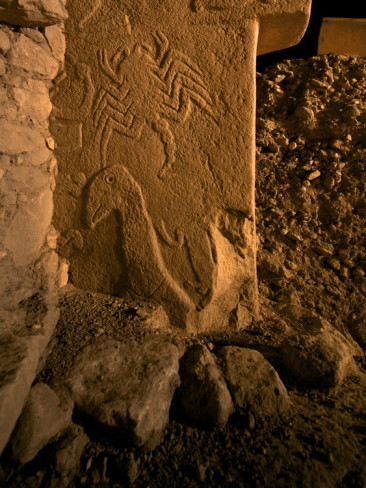
Göbekli Tepe is vaguely reminiscent of Stonehenge but it was built much earlier and not with blocks of stone roughly cutted but with limestone pillars finely sculpted in bas-relief. They are still visible parade of gazelles, snakes, foxes, scorpions, wild boar!

The Complex dates back to seven millennia before the Great Pyramid of Giza, and it is the oldest known example of monumental architecture. Around 8000 BC the site was abandoned deliberately and voluntarily buried with earth brought by man.

Archaeologists continue to dig and discuss its meaning. Göbekli Tepe and other sites in the Middle East are changing our ideas about a turning point in human history: the Neolithic Revolution, when hunter-gatherers were transformed into sedentary farmers.

The site is located on an artificial hill about 15 meters high with a diameter of about 300 m, situated on the highest point of elevation of a elongated shape which dominates the surrounding region, between the Taurus Mountains and the Karaca Dag and valley where the city of Harran. The site used by man would have had an extension from 300 to 500 square meters.

So far, less than a tenth of the site has been excavated. This gives an idea of ​​the awe inspired in the temple to the pilgrims who gathered here 7,000 years before the construction of Stonehenge.

Gobekli tepe

The Gobekli Tepe discovery

Gobekli Tepe was first identified in 1963 by a turkish-American research group. They noticed several piles consisting of fragments of flint, a sign of human activity in the Stone Age. The site was later rediscovered thirty years later by a local pastor, he noticed some odd shaped stones protruding from the ground.

The news came to the head of the museum of the city of Şanlıurfa, who contacted the ministry, who in turn got in touch with the German Archaeological Institute in Istanbul headquarters.
The excavations were begun in 1995 by a joint cooperation between the Museum of Şanlıurfa and the German Archaeological Institute under the direction of Klaus Schmidt. The latter was working in the previous year some archaeological sites in the region. In 2006 the excavations went to German universities of Heidelberg and Karlsruhe.

The excavations brought to light a monumental megalithic sanctuary, consisting of an artificial hill bordered by stone walls rough dry. They were also found four circular enclosures, bordered by huge limestone pillars weighing over 10 tons each, probably plucked with the use of stone tools. According to the Director of the archeological site, the stones pricked up and arranged in a circle symbolize an assembly of men.

The more interesting discovery concerns about 40 stones disposed to form a T high as five feet. The limestone blocks, weighing five tons, were brought here from a nearby quarry even if the wheel or domesticated beasts of burden were not yet introduced.

Most of them are engraved and they show the different types of animals (snakes, ducks, cranes, bulls, foxes, lions, boars, cows, scorpions, ants). Some recordings were voluntarily canceled, perhaps to prepare the stone to receive new ones. There are also decorative elements such as patterns of dots and geometric patterns.

Geomagnetic surveys have indicated the presence of other stones, almost 250 still buried in the ground. Another T-shape stone, extracted only half the quarry, was found about 1 km far from the site. It has a length of about 9 m and was probably intended for the sanctuary but from some reason was abandoned.

There are also some isolated sculptures, in clay, very ruined by time, which probably represent a boar or a fox. Comparisons can be made with statues of the same type found in the sites of Nevali choirs and Nahal Hemar.

The sculptors had to do their work directly on the plateau of the sanctuary, where they were also found stones unfinished and bowl-shaped cavity in the rock clay, a technique already used during the Epipaleolithic to get clay for sculptures or the clay binder used in the masonry.

In the rock there are also phallic representations, maybe go back to later periods, finding comparisons in Sumerian and Mesopotamian cultures (sites of Byblos, Nemrik, Helwan and Aswad).

Until now, 45 of these stones have been dug, but there are indications that there is much to discover. Geomagnetic surveys imply that there are hundreds more standing stones, just waiting to be brought to light. Gobekli Tepe would have been an extraordinary site. A kind of Turkish Stonehenge.

Several factors make of Gobekli Tepe archeology an isolated and unique case.
The first is its age. Radiocarbon dating shows that the complex is at least 12,000 years ago, perhaps even 13,000 years old.

This means that it was built around 10,000 BC. Gobekli Tepe is thus the oldest complex site constructed by Man in the world. It is so old that it precede the time when it is believed Man become sedentary. Gobekli comes from a part of human history that is unimaginably distant, deep past of hunter-gatherers.

How did cavemen build something so ambitious? The archaeologist Klaus Schmidt, thinks that bands of hunters would have gathered sporadically at the site, during the decades of construction, they lived in tents made of animal skin and kill the local game for food. The many flint arrowheads found around Gobekli support this thesis, but also support the dating of the site.

This revelation, that Stone Age hunter-gatherers could have built something like Gobekli, radically changes our view of the world, because it shows that the life of the ancient hunter-gatherers in this region of Turkey, was far more advanced than we ever conceived. It is as if Gods came down from heaven  and Gobekli had been built with their own hands.

Gobekli Tepe as a Constellation representation

The particular arrangement of the complex of Gobekli Tepe is also the arrangement of the main stars of the constellation of the Pleiades (also known as the Seven Sisters, called by the ancient Romans Vergilie) that count different stars visible at naked eye in the constellation of Taurus.

A few years ago, archaeologists found at Cayonu a pile of human skulls. They were found under a slab altar, dyed with human blood. No one is sure, but this may be the first evidence of human sacrifice: one of the most inexplicable human behavior, which could have developed only in the face of a terrible societal stress.

Experts are debating the evidence of Cayonu. But what no one denies is that human sacrifice took place in this region, including Palestine, Israel and Canaan. Archaeological evidence indicates that the victims were killed in huge death pits, children were buried alive in jars, others were burned in large jars of bronze.

These are almost incomprehensible acts, unless you think that the people had learned to have fear of Gods, because they had been driven out of paradise. So he tried to propitiate the wrath of heaven. This savagery may, indeed, be the key to a final solution, baffling mystery. The amazing stone friezes of Gobekli Tepe are preserved intact for a bizarre reason.

Long ago, the site was deliberately and systematically buried with a colossal work together with all its wonderful stone carvings. Around 8000 BC, the creators of Gobekli buried their realization and their glorious temple under thousands of tons of earth, creating the artificial hills on which the Kurdish shepherd walked in 1994. The reason that led the ancients to bury forever the temple of Gobekli Tepe remains a mystery.

Saturday, December 15, 2012

The Diamond Planet 55 Cancri e

by

The surface of 55 Cancers e, composed largely of graphite, is surrounded by a thick layer of diamond.


The universe is a bit 'more "rich" thanks to the discovery of the chemical composition of a planet located in a nearby constellation: it is made almost entirely of diamond.

This rocky planet, named 55 Cancri e, is large only twice the Earth but eight times the mass of our planet, characteristics which, according to a new study, making it a so-called "super Earth." This planet, observed for the first time in 2011 in front of its parent star, it takes only 18 hours to complete an orbit around its star. Consequently, the surface temperatures, which can reach 2150 ° C (conditions that make the planet uninhabitable) and carbon, create ideal conditions for the formation of diamonds.

Sunday, May 13, 2012

Mayan Prophecy The End of the World Revealed

by
According to Mayan prophecy the end of the world should be scheduled for December 21, 2012.

The denial, for those who still needed it, comes precisely from the same holders of the mournful prophecy: the Maya.

A group of archeologists who were investigating a buried city in Guatemala have unearthed for the first time a house adorned with Mayan murals. Alongside the paintings are the remain of calculations made by some mayan astonomers who refers of period of time far beyond the alleged fateful date December 21, 2012. The house belonged to a scribe, is one of thousands of buildings Xultún, a huge Mayan city (31 km wide) discovered about a century ago but still largely buried. The team of archaeologists led by William Saturno began to study it in 2010.

source: nationalgeographic

Tuesday, March 13, 2012

Nicolas Cage is a Vampire

by
Is Nicolas Cage a Vampire? This is not a new Twilight novel but this is according to a US antiquities who shows the evidences to those who accuse him of madness. A yellowed picture which depicts a man dressed in nineteenth century. Nicolas Cage a Vampire.

Wednesday, February 22, 2012

Einstein's Special Relativity is safe. Measurements on the Speed of Neutrinos are Incorrect

by
Measurements performed at CERN - GRAN SASSO ​​on the speed of neutrinos appear to be incorrect. The anomaly revealed during the experiment that took place on September 2011 seemed to uncover a revolution in physics and a violation of Einstein's special relativity. But that anomaly appears to be due simply to a failure of communication between a GPS device and the computer responsible for the registration of measured events.

It is a rude awakening for those who carried out the experiments and hoped to found a violation in the most simple and elegant theory ever devised by human mankind (Einstein's special relativity), but surely a relief for a generation of theoretical and experimental physicists who have spent a lifetime in studying based on the knowledge acquired by the theory of Einstein.

As I reported in various posts (eg see here) it is very likely that the laws of special relativity should be generalized to very high energies up to embrace a new universal constant, the Planck length, exactly in the same way the velocity of light c is. This deviation allows superluminar velocity for particles with very high energy. But clearly the conditions of the experiments performed at CERN-Gran Sasso have not the peculiarities nor the energy to unveil a deviation from Einstein's Special Relativity.

For who do not know about Einstein Theory here it is Special Relativity explained in 5 minutes.


Saturday, December 17, 2011

Biomasse plant with sawmill residues in Honduras

by

This carbon offset project in Honduras installs a biomass plant which will run on biomass residues of about 20 saw mills. CO2 emissions are being reduced by displacing the use of fossil based electricity by clean and sustainable electricity produced by this renewable energy source.
In Talanga, Honduras, in the Regional Association of Sawmills Francisco Morazán (ARIDEMA- Asociación Regional de Industriales de la Madera de Francisco Morazán) a ‘first of its kind’ two Megawatt gasification reactor will be installed. It will run on biomass residues of about 20 small saw mills that are associated in the ARIDEMA. The generated clean and sustainable electricity shall be exported to the Honduran national grid. CO2 emissions are being reduced compared to the situation without project by displacing electricity from other sources like the national on fossil fuel based grid or generators running with fuel oil. 

Saturday, November 26, 2011

Neutrinos Faster Than Speed of Light?

by
Since Einstein stated than c, the speed of light in vacuum, is a universal constant in nature, several experiments have been made confirming this assumption. Recently Scientists in Switzerland say an experiment appears to show that tiny particles traveled faster than the speed of light -- a result that would seem to defy the laws of nature. The physicists say that neutrinos sent 730 kilometers (453.6 miles) underground between laboratories in Switzerland and Italy arrived a fraction of a second sooner than they should have, according to the speed of light.

The physicists say the measurements of the distance and the time involved were performed with great precision, to nanosecond accuracy. And the results seemed to show the neutrinos travel "at a velocity 20 parts per million above the speed of light, nature's cosmic speed limit."

Tuesday, June 14, 2011

Italy Against Nuclear. Boost in Renewables Hope

by
Italians have voted against rebooting nuclear power generation, thwarting prime minister Silvio Berlusconi’s nuclear ambitions and signalling a potential shift toward renewable energy.

This week’s two-day referendum saw nearly 95% of voters reject the reintroduction of nuclear power generation. Berlusconi had wanted to revive the country’s nuclear programme after it was dropped more than two decades ago following the Chernobyl disaster.

The referendum – in which the electorate also rejected the privatisation of municipal water supplies and legislation that protects the prime minister from prosecution – attracted a turnout of around 57%, more than the 50% required to make the results legally binding. As the outcome of the referendum became clear, Berlusconi told media on Monday that Italy “must probably say goodbye” to nuclear and commit itself to renewable energy.

Shares in Enel Green Power, the renewable wing of Italian utility Enel, rose more than 3% to €1.99 ($2.87) following news of the referendum.

Lee Clements, an investment manager at Impax Asset Management in London, said Italy’s nuclear rejection may be positive for renewable energy and energy efficiency initiatives in the long run. However, with nuclear now firmly off the table and solar power subject to continued regulatory uncertainty, natural gas is most likely to fill the gaps in additional energy capacity in the short- to medium-term.

The nuclear result may also push Italy to be more proactive in expanding its European grid connections, he added.

Italian voters echo German anti-nuclear sentiment
Italy’s poll comes hot on the heels of the recent nuclear backlash in Germany.

Last month, Germany announced that its oldest seven nuclear reactors, which were suspended in the wake of Japan’s Fukushima disaster, will be permanently closed, with a total of 17 nuclear plants to be shut down by 2022. Chancellor Angela Merkel also vowed to double Germany’s 2020 renewables target.

Italy’s referendum also points to the waning popularity of the Italian prime minister. Berlusconi – who features on the cover of this week’s edition of The Economist as “The man who screwed an entire country”– was defeated in local Milan elections last month and is widely said to have used his media influence to dissuade voter participation in the referendum.

environmental-finance.com

Monday, May 23, 2011

Iceland volcanic ash cloud forces airlines to change flight schedules

by
The last time an Icelandic volcano with an unpronounceable name spewed forth a thick cloud of ash, it led to crippingly expensive airport shutdowns, weeks of delays across Europe, and left tens of thousands of travellers stranded.

As a plume of ash once again drifts towards Scotland from the north Atlantic, experts insist that this time will be different, and new rules will permit more aircraft to brave the cloud.

But as aviation authorities admitted they did not yet know how badly flights would be affected, airlines including BA, Aer Lingus, KLM, easyJet and Flybe grounded services due to take off today.

Barack Obama and his entourage took no chances, preferring to skip a planned one-night stay in Dublin and fly in to London last night for the US president's state visit.

What is known is that the densest parts of the ash cloud from the Grimsvötn volcano are expected to exceed a new safety threshold set for airlines, and services at a dozen airports, including Glasgow and Edinburgh, are already under threat.

A string of carriers have announced changes to their schedules, with BA stating that it will not operate any flights between London and Scotland before 2pm today.

KLM said 16 flights scheduled for today to and from Glasgow, Edinburgh, Aberdeen and Newcastle would be cancelled, while Eastern Airways, based in Lincolnshire, axed all flights. Loganair, a regional carrier based in Glasgow, cancelled 36 flights.

The air safety watchdog for British airlines and airports, the Civil Aviation Authority, said particles from Grimsvötn could affect transatlantic journeys by reaching western England on Thursday or Friday, depending on wind direction.

High winds had already caused disruption to rail and road users in Scotland and northern England , with 100mph winds disrupting motorists, rail users and homeowners in Scotland, causing mass cancellations of rail services, and power cuts. Eastbound traffic on the M62 between Leeds and Manchester was brought to a standstill, while three racing yachts were rescued after high seas disrupted an event between Whitby and Scarborough. The winds are expected to affect ash cloud forecasts. The Met Office warned of difficulties in tracking the cloud's progress because of erratic shifts in wind direction. If airspace in western England, Ireland and the Atlantic is affected by the plume, US-bound flights from Heathrow could see delays later this week as planes are diverted around the densest parts of the cloud.

But the CAA said it was confident that a new Europe-wide safety regime introduced after the Eyjafjallajökull eruption last year would reduce disruption and avoid the continental shutdown that stranded millions. Under the new operating procedures, it is understood that the effect of last year's plume on commercial routes would have been reduced by 75%.

Andrew Haines, the CAA's chief executive, said: "Our number-one priority is to ensure the safety of people both on board aircraft and on the ground. We can't rule out disruption, but the new arrangements that have been put in place since last year's ash cloud mean the aviation sector is better prepared and will help to reduce any disruption in the event that volcanic ash affects UK airspace."

Under previous guidelines, aircraft were summarily grounded if there was any volcanic ash in the air. Now, airlines can fly through ash plumes if they can demonstrate that their fleets can handle medium- or high-level densities of ash.

The Met Office's volcanic ash advisory centre will track the cloud, aided by satellite images, weather balloons and a radar specially installed in Iceland last year. Once those zones are relayed to airlines, they will need to prove that they can fly through them by producing "safety cases" that will include information from aircraft and engine manufacturers on the airline's tolerance to volcanic ash.

The transport secretary, Philip Hammond, said that the ash had already caused "modest delays" to flights, including some Atlantic services.

"Clearly, this is a natural phenomenon which we cannot control, but the UK is now much better prepared to deal with an ash eruption than last year," he said.

"Our investment in new equipment to better monitor ash concentrations and our development of new operating procedures for airlines will all help to lessen the impact the eruption will have on UK aviation.

A CAA spokesman said: "Safety will still be paramount, but we will be able to drastically reduce disruption compared to last time, provided there is not a huge amount of high-density ash." The spokesman said a similar level of ash to the Eyjafjallajökull incident would not result in a mass-grounding. "It will be a different picture." However, jets would still have to divert around high-density clouds, causing delays on some routes, because no UK airline has submitted a safety case for flying through heavy ash plumes.

BAA, owner of Heathrow, Stansted, Edinburgh, Glasgow and Aberdeen airports, has convened a crisis team to prepare for a cut in flights, as airlines and airports await a briefing from Eurocontrol and the UK air traffic controller, Nats..

Under the new ash guidelines, cloud densities are split into three levels: low, medium and high. Once the Met Office assigns a particular density of ash to a section of airspace, airlines must prove they have the safety case to fly through it. A low density cloud is 2g of ash per 10 cubic metres of air, with medium being 2g to 4g of ash per 10 cubic metres. Anything above 4g is deemed high density.

The Grimsvötn volcano began erupting at the weekend, causing flight cancellations at Keflavik airport after it sent a plume of ash, smoke and steam 12 miles into the air. Helen Chivers, a Met Office spokeswoman, said: "At the moment if the volcano continues to erupt to the same level it has been, and is now, the UK could be at risk of seeing volcanic ash later this week. Quite when and how much we can't really define at the moment."

She said the weather situation was likely to be different from last year, with the wind direction set to change continuously. She added: "If it moves in the way that we're currently looking, with the eruption continuing the way it is, then if the UK is at risk later this week, then France and Spain could be as well."

While the ash has grounded aircraft in Iceland, it is not anticipated that it will have a similar impact in the rest of Europe.Dr Dave McGarvie, volcanologist at the Open University, said the amount of ash reaching the UK was "likely to be less than in the 2010 Eyjafjallajökull eruption", and the last two times Grimsvötn erupted it had not affected UK air travel.

"In addition, the experience gained from the 2010 eruption, especially by the Met Office, the airline industry, and the engine manufacturers, should mean less disruption to travellers," he said.

The eruption of the Eyjafjallajökull volcano in south-east Iceland in April 2010 caused the worst disruption to international air travel since 9/11. Flights across Europe were cancelled for six days, stranding tens of thousands of people, and the eruption was estimated to have cost airlines £130m a day.

Eurocontrol said in a statement: "There is currently no impact on European or transatlantic flights and the situation is expected to remain so for the next 24 hours. Aircraft operators are constantly being kept informed of the evolving situation."

guardian.co.uk

Sunday, May 22, 2011

Area 51. No UFO. Declassified CIA documents reveal

by
The CIA has declassified the operation that served to remove any trace of the secret project. In 1963 a secret invisible aircraft has been developed in the secret Area 51.

The CIA created Area 51 in 1955 to develop and test some secret military projects in the isolated desert of Nevada. More than 50 years later, the base officially does not exist yet, and will not appear on U.S. government maps.

In the fifties and sixties The Area 51 was the center of the Oxcart project, which aimed to set a spy plane that was supposed to take the place of the U-2, which became famous in the early years of the Cold War for photos in strategic locations of enemies that could be triggered by high fees.

During the approximately 2,850 flight ultra secret tests, many people managed to see the same strange (for the time) figures of futuristic aircraft.

Unrecognizable even to air traffic controllers and pilots of commercial aircraft, sightings of shiny titanium aircraft contributed to the growing rumors of a hypothetical presence of aliens (UFO, unidentified flying objects) in the Area 51.

As a result of the project was produced Archangel-12 or A-12, the first true invisible to radar airplane, according to several experts.

The A-12 is capable of flying at 3,220 km / h and cross the continental United States in 70 minutes and at the same time taking pictures sharp enough to detect an object of 30 cm from a height of 27 thousand meters.

Here are some photos (credit National Geographic). Click on a photo to start slideshow.


Tuesday, May 17, 2011

Berlusconi punished in local elections

by
Silvio Berlusconi’s surprisingly poor showing in local elections in his Milan stronghold has exposed cracks in the ruling centre-right coalition, raising doubts over the prime minister’s future.

Berlusconi, who presented the local contest as a referendum on his government, is widely seen in Milan to have been punished by his core electorate following a bitter campaign that failed to dispel voter disillusionment after months of sex and corruption scandals and the government’s handling of a stagnant economy.

read the full story

Sunday, May 15, 2011

An Eye for an Eye: Iran's Blinding Justice System

by
Iran's judiciary has postponed the blinding of a man as punishment for throwing acid in the face of a young woman in 2004, after she rejected his offer of marriage. The delay came in the face of mounting outcry both inside Iran and in the West over the sentencing, which is permissible under qesas, a principle of Islamic law allowing victims analogous retribution for violent crimes.

The case has stirred passionate interest in Iran since 2004, when Majid Movahedi, a university student, accosted Ameneh Bahrami on a Tehran street and tossed a red bucket of sulfuric acid in her face. Bahrami, an attractive young engineer, had repeatedly spurned Movahedi's proposals and reported his harassment to the police. She was blinded and severely disfigured in the attack, and has spent the intervening years between Iran and Spain undergoing numerous unsuccessful operations to reconstruct her face and repair her sight.

Much of the public outcry in Iranian media, news websites, and blogs, surrounds the Iranian legal system, which produces such verdicts by practising an 'eye for an eye' approach to justice based on seventh century Islamic jurisprudence. These principles effectively offer victims of violent crime two legal choices, forgiveness or qesas, analogous retribution. "Bahrami must sit in the place of the judge and either forgive her attacker or take revenge" says Asieh Amini, an Iranian women's rights activist living in Europe? "The legal system pushes her into a dead-end, and it's really the law that's deficient here." Bahrami eventually chose qesas, determined that her experience would serve as deterrence for future crimes. "I want people like him to know that they will suffer forever if they cause someone such suffering," she said on BBC Persian television Saturday.
Speaking on the interactive television program Saturday, Bahrami said she favored a more modern course, suing for damages. "I want him to be punished foremost. But if there are human rights considerations, then I'll accept two million Euros and his life imprisonment," she said. The program featured an emotional exchange between Bahrami and Movahedi's weeping mother, who begged for her forgiveness. It drew a flood of callers from inside Iran, many of them concerned that Bahrami's "forgiveness," while perhaps the most humanitarian course, would encourage such a horrific crime by implying legal leniency. "Ameneh, daughter of Iran, we understand your joy and we support you," wrote a prominent Iranian blogger, Dalghak Irani, featured on the program.

Bahrami, who was scheduled to herself administer the blinding drops to an anaesthetized Movahedi, learned of the delay outside the Judiciary Hospital in Tehran. Human rights groups and Western governments pleaded with Iranian authorities last week to call off the punishment. Iran's government usually responds to such foreign pressure by lashing out rather than backing off, but Bahrami's case poses a unique dilemma: unlike many human rights cases which excite opinion primarily in the West, it has resonated deeply throughout Iranian society; the attention inside Iran raises the prospect of a public backlash at a time when the regime is deeply divided by political infighting. "There's no doubt public opinion inside Iran has been stirred up," says Amini. "There's been a huge outpouring of sympathy for both of them, and this puts pressure on the government."
Apart from its headline-grabbing story line, the case is transfixing Iranians because it reflects how their society's old mores are clashing with modern norms. This was no village crime committed by an illiterate, but a tragedy that unfolded in the nation's capital between two educated urbanites. It underscores how Iranian women's social standing — they are now in the majority at universities and active throughout society — fits awkwardly with deep-seated patriarchal attitudes. Women direct top-grossing films in Iran, run galleries, and write best-sellers, but are still covered by cultural mores that often approximate the severe conservatism of neighboring Afghanistan. "This case really highlights the sexist attitudes and double standards within Iran society," says Nayereh Tohidi, an Iran expert and a professor of women's studies at California State University, Northridge. "[Based on] such customs, a man sees it as his prerogative to want and possess the woman he desires, regardless of her feelings and mutual love." Tohidi adds, "This 'eye for an eye,' tribal approach to crimes underlies how the law reinforces a cycle of violence instead of reducing it. A young blind man is going to be added to a young blind woman for society to take care of."


Read more

Saturday, May 16, 2009

'Angels' flying lower than expected

by
It seems that 'Angels and Demons' is ecountering less successful than one had expected. I read the book and I found it very interesting and suited to be the plot of a film. Have You already seen the film? Below is the article of hollywoodreporter.com.

Bedeviled by mixed reviews and weak interest among younger moviegoers, Sony’s Tom Hanks starrer “Angels & Demons” hit domestic theaters a bit sluggishly on Friday, gathering $16.6 million from 3,527 venues.

Monday, February 23, 2009

US, as the production from renewable is growing

by

The contribution of clean energy  electricity production in U.S. is rapidly Increasing: 6.1% more for thesolar panels hydroelectric and 10% for the other renewables.

In agreement with the analysis made by the Sun Day Campaign to the latest data published by the Energy Information Administration (EIA), a division of U.S. Department of Energy report "Electric Power Monthly" shows that the stars and stripes area is significantly increasing in national electricity production for the period November 2007 - November 2008 of renewable energy.

This is an increase especially important considering the decrease recorded at the same time period from coal and nuclear, respectively 2.7% and less than 2.3%.

According to EIA the production of renewable energy, including hydroelectric and conventional industry, has increased by 7.3%, with the wind once again as the best. The report estimate shows, in fact, as in 12 months the wind energy production has increased by 42.4%, with peaks of generation in Texas, California, Minnesota, and Illinois.

Friday, February 20, 2009

Found self-portrait of Leonardo da Vinci

by

leonardo da vinci
It has been found to Acerenza, in the province of Potenza (Italy), a hypothetical portrait of Leonardo da Vinci. The work, a table of 60 to 44 centimeters painted by oil presumably in the sixteenth century, could be of Cristofano dell'Altissimo or even a self portrait of Leonardo himself. The work, discovered by Nicola Barbatelli, Researcher of medieval history, is now entrusted to the Director of the Museo Ideale Leonardo Da Vinci, Alessandro Vezzosi, who will examine and trace the exact paternity.

According to the reconstruction of Barbetelli, the table is belonged to the noble family of Tuscany origin dei Segni which had developed close friendship with the artist and that was subsequently established to Acerenza. The painting depicts three quarters of Leonardo and his hat, like the so-called "Autoritratto" in the Uffizi, as considered for two centuries until, in 1938, an X-ray has denied definitively the leonardian autography. Among other things, we must determine whether the portrait is earlier or later than Florentine.

Monday, November 17, 2008

What Has Driven Women Out of Computer Science?

by

ELLEN SPERTUS, a graduate student at M.I.T., wondered why the computerimage camp she had attended as a girl had a boy-girl ratio of six to one. And why were only 20 percent of computer science undergraduates at M.I.T. female? She published a 124-page paper, “Why Are There So Few Female Computer Scientists?”, that catalogued different cultural biases that discouraged girls and women from pursuing a career in the field. The year was 1991.

Computer science has changed considerably since then. Now, there are even fewer women entering the field. Why this is so remains a matter of dispute.

What’s particularly puzzling is that the explanations for under-representation of women that were assembled back in 1991 applied to all technical fields. Yet women have achieved broad parity with men in almost every other technical pursuit. When all science and engineering fields are considered, the percentage of bachelor’s degree recipients who are women has improved to 51 percent in 2004-5 from 39 percent in 1984-85, according to National Science Foundation surveys.

When one looks at computer science in particular, however, the proportion of women has been falling. In 2001-2, only 28 percent of all undergraduate degrees in computer science went to women. By 2004-5, the number had declined to only 22 percent. Data collected by the Computing Research Association showed even fewer women at research universities like M.I.T.: women accounted for only 12 percent of undergraduate degrees in computer science and engineering in the United States and Canada granted in 2006-7 by Ph.D.-granting institutions, down from 19 percent in 2001-2. Many computer science departments report that women now make up less than 10 percent of the newest undergraduates.

In 1998, when Ms. Spertus received her Ph.D. in computer science, women received 14 percent of the doctorates granted in the field. Today, she’s an associate professor at Mills College and a research scientist at Google. Her life story supports the hypothesis of Jane Margolis, co-author of “Unlocking the Clubhouse: Women in Computing,” who highlights the ambient ideas in a family that are enormously influential in career decisions.

Last week, Ms. Margolis said that “a lot of the girls who were doing computer science came from families of computer scientists and engineers.” Her explanation: “It was in the air. There was the expectation that they could do whatever they wanted.” Ms. Spertus’s father was an M.I.T.-trained engineer. She learned programming even before personal computers had arrived, using computer terminals in her house that were connected to a Honeywell mainframe used by the family’s business.

Twenty-five years ago, more young women in colleges and universities were drawn to computer science than today. From 1971 to 1983, incoming freshman women who declared an intention to major in computer science jumped eightfold, to 4 percent from about 0.5 percent.

Jonathan Kane, a professor of mathematics and computer science at the University of Wisconsin-Whitewater, recalls the mid-1980s, when women made up 40 percent of the students who majored in management computer systems, the second most popular major on campus. But soon after, the number of students majoring in the program had fallen about 75 percent, reflecting a nationwide trend, and the number of women fell even more. “I asked at a department meeting,” he says, “ ‘Where have the women gone?’ It wasn’t clear.” His theory is that young women earlier had felt comfortable pursing the major because the male subculture of action gaming had yet to appear.

Justine Cassell, director of Northwestern University’s Center for Technology & Social Behavior, has written about the efforts in the 1990s to create computer games that would appeal to girls and, ultimately, increase the representation of women in computer science. In commenting as a co-contributor in a new book, “Beyond Barbie and Mortal Kombat: New Perspectives on Gender and Gaming,” Ms. Cassell writes of the failure of these efforts, “The girls game movement failed to dislodge the sense among both boys and girls that computers were ‘boys’ toys’ and that true girls didn’t play with computers.”

She said last week that some people in the field still believed that the answer to reversing declining enrollment was building the right game. Another school of thought is what she calls the “we won” claim because women have entered computer-related fields like Web site design that are not traditional computer science. Ms. Cassell points out that it’s not much of a victory, however. The pay is considerably less than in software engineering and the work has less influence on how computers are used, and whether this actually accounts for the diminishing numbers of female computer science majors remains unproved.

Ms. Cassell identifies another explanation for the drop in interest, which is linked to the pejorative figure of the “nerd” or “geek.” She said that this school of thought was: “Girls and young women don’t want to be that person.”

I spoke with Ms. Spertus last week about her thoughts about the declining percentage of undergraduate women majoring in the field. “Women choosing not to go into computer science is fine,” she said, “if there aren’t artificial barriers keeping them out.” She lamented the recent decision of one of her outstanding computer science students who chose to major in nursing because of what the student perceived as better prospects for finding employment.

Such students who choose not to pursue their interest may have been introduced to computer science too late. The younger, the better, Ms. Margolis says. Games would offer considerable promise, except that they have been tried and have failed to have an effect on steeply declining female enrollment.

At least we know one thing: it’s possible to have about the same number of men and women in computer science classes. That just about describes classrooms of 25 years ago.

(original paper)

Sunday, November 16, 2008

Obama and science. Changes for science

by

The results of U.S. elections also involve research and environment. Here'simage the scientific program of the future president of the United States of America.
For celebrations of the night of Nov. 4 to Chigago were also attended numerous scientists. Among the multitude of supporters of the new American president has distinguished itself, in fact, a spontaneous coming from the world of scientific research. The expectations also change science, said the U.S. magazine Science: there are many scientific questions that every day should come to terms with politics and the rest of society. Today, the American science  sees its world leadership in crisis. If the years following the Second World War science and technology were key levers for economic growth in the United States, today this leadership is threatened by global competition which sees the new powers such as China, India, Brazil on the one hand, and on the other financial crisis. These reasons have meant that the scientists push American candidate in American public exposure of their political agenda on issues that have to do with policy research, education and environmental policies.
Here, briefly, some of the scientific program key points of the future U.S. president Barak Obama.

Innovation:

Science and technology are priority areas for the administration of the new president who wishes to increase funding for basic research in physics, mathematics, in life sciences, engineering with the aim of doubling the investment over the next decade. Special attention is given to young researchers who want to pursue a scientific career, which will be allocated more scholarships. The new government is committed to support research programs at high risk (and high-result) in all research American institutions, and invest in innovative research that meet the energy needs of the country and the transformation of defense projects.

Climate change:

Barack Obama answered questions from scientists about global warming claiming that now there are doubts about human responsibility to improve the global temperature: You must react quickly and appropriately. Abrupt change of direction then compared to Bush. Obama argues that the United States must assume a global leadership role in the development of technology and economy that aims to reduce by 2050 emissions of carbon dioxide by 80%. Environmental policy also will include the implementation of cap and trade system, a flexible system of emissions trading among the U.S. states, which already has proven very effective in Europe. One of the first tasks of the future administration will be to set targets for reducing greenhouse gas per year, with the objective to bring lair 2020 levels of carbon dioxide emitted to those of 1990.
The new administration will work actively with the international community to combat global warming, and create the Global Energy Forum, which will work the G8 countries along with five other world powers: Brazil, China, India, Mexico and South Africa.

Energy:

How to promote U.S. economic growth and at the same time reduce the environmental impact of the country? Obama responds by supporting more efficient energy use, hence the need for action on two fronts: on the one hand we need to support research on alternative and renewable energy with an investment that within the next ten years will reach 150 billion dollars, the other to provide incentives for retraining and adoption of technologies based on renewable energy. The research includes: the development of alternative fuels, urban technologies for energy saving, new vehicle design with reduced consumption, storage and distribution of new concepts, technologies for the storage of atmospheric carbon dioxide, and a new generation nuclear technology for electricity generation safer and more environmentally compatible.

School:

The science education should be more accessible, not only those intending to pursue a scientific career, but to all American citizens so they can participate actively in political decisions involving this type of knowledge. The effort will be to work to ensure that even the most disadvantaged have access to scientific knowledge. The new administration will support research on science education, including innovative, and, recognizing the central role of teachers in the formation of citizenship, seeks to improve their condition, including economic, within the school system. Naturally, the measures would cover not only teachers of science: The objective is to achieve a high standard of quality in all areas of school education.

Genetic research:

The potential of genetic research for the improvement of health and human nutrition is enormous but it is also true that there are important ethical, legal and social implications that must not be neglected. The genetic information of a person, for example, may be useful for diagnosis of risks to his health, but could also be used to discriminate against this individual. For this reason Obama supports the law on genetic discrimination not recently been approved by the U.S.. Obama also supports genetic research in agriculture and medicine, but under close supervision by the state to protect the safety and health of citizens.

Stem cells:

Consider the promises that come from this line of research, Obama will support research on stem cells and eliminate restrictions on the acquisition of new cell lines established by Bush. Of course the state will ensure that research is conducted in strict ethics and respect for life umana.Se is true that research on stem cells requires to be taken from human embryos, supports the new U.S. president is also true that in clinics assisted fertilization American esistomo hundreds of thousands of frozen embryos that are not used to playing for and that will be destroyed. Obama believes therefore ethical to use these embryos for the purpose of medical research that can save future in many ways human. Some believe that embryonic stem cells can be replaced by adult ones, but Obama is different view: they do not have the versatility of embryonic ones and can not replace them and until you can reprogram the adult ones remain embryonic material better to work on.

Health of the Sea:

75% of world fish stocks are in serious decline and coral habitats are threatened. The sea is an important resource: controls the climate and weather events on our territory, is a valuable source of food, employment, whether for fishing and for tourism. According to Obama is therefore essential to undertake policies to preserve the marine environment. In addition to act to reduce emissions of greenhouse gases and support research in environmental matters, the United States should ratify the Convention on Sea, an agreement ratified by more than 150 countries. The new government will strengthen control over U.S. coasts and beaches, including strengthening respect for national marine sanctuaries.

Water:

Thirty-nine U.S. states over the next ten years will be at risk of water shortages. According to Obama, the solution to this problem requires the coordination of federal, state and local governments, and individuals and businesses involved. Prices and policies will work to encourage the efficient use of resources. The state will support the farmers to adopt more sustainable practices in respect of water use, through information, education and economic resources. It will also require a substantial investment to develop new technologies designed to optimize use of water.

Basic research:

The concerns of scientists worried that the global crisis could jeopardize funding for research, Obama risposnde reiterating that basic research was of great importance for the United States in recent cinqunt'anni, and that even when search results do not seem to have practical implications, the impact of technological research often have a huge scope. This is why the new government actually intends to support basic research, doubling the funds in the next ten years, and changing the trend in recent years has seen decreasing investment in this sector.

Health:

Americans are increasingly concerned about the costs of healthcare, increasingly prohibitive, and now out of reach for a large slice of Italian nationality. Obama considers unfair that the American health care system work better for insurance companies and for the people. For this reason, the new administration intends to make health insurance more reliable and economical, and to ensure that only covered through taxes paid by salary. Every citizen can also choose their own doctor.

(translated from: amantea.net)

Friday, November 14, 2008

first photos of Extrasolar planet: Fomalhaut b and all his rings

by

After eight years of trying, a group of researchers at Berkeley (California-image USA) finally managed to photograph a Extrasolar planet that could be for the stronger, more similar to Earth than all those discovered so far. It is located just 25 light years from us and probably has a mass similar to that of Jupiter. The object orbiting the star Fomalhaut at a distance equivalent to about 4 times what there is between Neptune and our Sun, which is about 4 billion and a half kilometers. When the planet was given the name of Fomalhaut b, according to early indications, could be surrounded by a group of rings similar to those that Jupiter possessed before the material will thicken in the Galilean satellites known.
"Already in 2005 we advanced the hypothesis that the ring of dust surrounding the star could accommodate a large planet, as we noted a particularly devoid of material. This could mean that a planet had to himself aggregate objects that filled that space. Now, finally, we have visual proof that there really is a planet, "said Paul Kalas, head of research, which is published in Science.
In most cases Extrasolar Planets are not searched through photographs, because the instruments now in possession hardly able to identify them close to their stars, but through techniques that exploit the fall of light that they are causing to their star when they pass in front. Or through methods that detect changes in the trajectory of the stars around which orbit, following that of Attraction gravitational planets exert.
Attempts to photograph the planets were made only infrared telescopes pointing towards young stars hoping to observe planets in formation still hot. In the case of Fomalhaut b but has tried in visible light and so the result is considered exceptional. A chronicle of honor already in another case spot Gemini telescope in Hawaii had photographed a likely Extrasolar planet, but he has a mass of 8-9 times that of Jupiter and thus more closely to the "brown dwarf" (objects that are a middle ground between planets and stars) is not a true planet.
"Fomalhaut b is located within a band of dust so rich that it is very likely that it is mainly rocky, or at least have a solid nucleus very substantial," said Eugene Chiang, co-author of the research.
The hopes of finding life on the planet, however, are almost zero. Its star is home to only 200 million years and will live for no more than a billion years, because too little on the planet inneschino conditions to support life (our Sun is 4.5 billion years and will live for a equally long time). The short life of the star that makes it 16 times brighter than our Sun and that the light on the planet appears similar to that of our star that is observed by Neptune, although b Fomalhaut is at a distance by 4 times higher Its parent star.
In these days comes another discovery of planets extrasolari, which will be also published in Science. This is a real family of planets brought to light by the Gemini telescope. Thanks to this fact, researchers from the Lowell Observatory have revealed that around the star HR 8799, there are three planets that are about 60 million years. According to some estimates, they should have a mass of 7, 10 and 10 times that of Jupiter and have a diameter of between 20 and 30% above the giant planet.
To date Extrasolar Planets are discovered orbiting 322 and 276 stars. But there is to be sure, it was only the beginning.

(italian source: repubblica.it)

Saturday, October 4, 2008

An aptitude test, designed to identify 'diagonal thinkers'

by


There are few outward signs that Tim Lindsay isn't completely straight. A family man in his fifties and president of advertising giant TBWA, with a client list of international brands that include Apple, Adidas, Mars, McDonald's and PlayStation, Lindsay appears to be a highly successful, even conventional, senior manager.

Yet Lindsay has a secret. According to an aptitude test designed by the advertising industry to pull it out of its white, middle-class rut, Lindsay is, to date, the most "diagonal thinker" in the world.

You may have heard of linear thought - the ability to think logically. And you're probably aware of lateral thinking - the ability to think creatively. But diagonal thinking is a new concept dreamed up by the advertising business to describe the combination of the linear and lateral thinking needed to succeed in creative jobs.

"It's the ability to switch effortlessly between linear, logical thought processes to lateral, creative ones," explains Hamish Pringle, director general of advertising trade body the Institute of Practitioners in Advertising (IPA), "and it seems to be one of the defining characteristics of people who do well in our industry. If you're just linear, you should, perhaps, be an accountant. Just lateral and maybe you should be in fine arts. But if you're a diagonal thinker, you are equipped to succeed in all the main roles in advertising."

According to the IPA 10% of the population can think diagonally. If you're curious to find out if you're a diagonal thinker - or keen to land a creative job - try taking the IPA's free hour-long, online aptitude test. "Anyone scoring more than 90% can print out an IPA certificate proving their scores and attach it to their CV," says Pringle. Proof of talent will become, he reckons, "their passport to Adland".

The test has been endorsed by the government which included it in a Creative Britain strategy document published earlier this year and was officially launched last week by culture secretary, Andy Burnham, at a festival held in London's Golden Square to promote the creative industries.

With the financial sector in crisis, the government sees the creative industries as key to Britain's future economic success. Currently accounting for more than 7% of GDP, the creative sector is growing at twice the rate of the wider economy and is on course to become the second largest contributor to the UK economy by 2018.

And yet it's an industry perceived as being riddled with institutional snobbery and elitism. Pringle admits that "diagonal thinking" is only the latest effort by creative industries desperate to shed their reputation as a refuge for the pampered bourgeoisie.

"There's a self-reinforcing cycle of largely white, middle class, university-educated students who are friends and family of similar people already employed throughout the top levels of the industry," he says. "They're the ones who get the scarce work experience positions, receive coaching on completing job applications and the interview process, and end up winning one of the rare jobs on offer."

Sure enough, a recent IPA survey found that only 6% of advertising people come from ethnic backgrounds - not so bad compared with the national average of 8%, but pretty shocking when compared with the London figure of 40%.

It doesn't help that agencies perpetuate the practice of wageless work placements and low entry-level salaries - an average of £17,000 per annum compared with £30,000 you might earn in a law firm, making it nigh impossible for graduate trainees with student debts to afford to live in London without family support. "If you're not already in our 'village', and from a non-white, non-graduate, non-middle class background, it's very hard to break in," concedes Pringle, "and the lack of role models makes it look as if Adland doesn't want you anyway."

Meanwhile Lindsay expresses surprise at being the highest-scoring diagonal thinker among the 200 people who have trialled the test. "I've always known I have both linear and lateral thinking skills, but always thought I was never quite good enough at either," he says.

But he reckons that it confirms what he has long looked for when recruiting fresh blood. "I always ask them about their enthusiasms - whether they read the FT and the Economist," says Lindsay. "But I also ask them who their favourite directors are and why.

"You need diagonal thinking in advertising to be able to come up with relevant creative ideas and innovative business ideas, and secondly to be able to judge creative ideas. But most of all you need it to manage creative types - often borderline sociopaths who just don't play by the rules."

The test has only been available for a few days, but the trials have already produced results. In 2001 Lucia Hargasova came to the UK from Slovakia where her father was a builder. After a couple of years of nannying she was sufficiently fluent in English to put herself through a degree at London Metropolitan University. She took part in the diagonal thinking trials before she graduated this year and, to her surprise, scored in the top 10%. It helped her secure four job interviews and she is now a trainee media planner for media agency Starcom.

"It was straightforward. Time pressured, but not difficult," she recalls. "But there's no doubt that my test results opened doors for me that might otherwise have remained closed."
How to do the diagonal thinking test

The diagonal thinking test is a cocktail of psychometric measures which identify the linear and lateral thinking styles, and personality traits that have been proven to be characteristic of people who do well in the advertising business, explains the occupational psychologist John Gage who developed the test. Try answering the following:

Lateral thinking question
You are managing director of a small but successful catalogue clothing business aimed at professional people within the UK with above average incomes. Your clothing is priced generally around 80% higher than your nearest competitor, but sells well to its market as it is seen as unique in design, high quality and British made. You are deciding whether to expand your target market or to re-brand to make your business even bigger and better.

List as many factors and issues you would need to take into account making this decision.

Linear thinking question
Should all British householders be fined for failing to recycle at least 70% of their household waste?

Questions like this measure your ability to judge whether an argument is a good or poor one in relation to the question presented. A good one would be important and related to the question, while a bad one would be if it is of minor importance or related only to trivial aspects of the question. For example, a poor argument might be "No - fining schemes usually backfire as people often rebel against them. It should be up to each individual household to decide on the amount of waste they wish to recycle." In contrast, a good argument might be: "Yes - this would encourage the average British citizen to think more about their recycling habits."

About RoxBlog Trends

by
RoxBlog Trends is a blog that takes care of my interests and my trends.

I like science, sport, politics, energy policy, music, mysteries and much more. Discover all the Trends on the labels. 


Il you like RoxBlog Trends you can consider to subscribe to RoxBlog-Trends feeds.


You can contact me leaving a message in the form that you can find here.

You can also add me on Facebook or GooglePlus.


Top Ad 728x90