Top Ad 728x90

Showing posts with label scientific mysteries. Show all posts

Sunday, September 7, 2014

A Gardner's Discovery Solves The Stonehenge mystery

by
The Stonehenge mystery solved by a gardener is making news headlines this week, and it makes many people wonder why a gardener is solving a Stonehenge mystery that eluded archaeologists and historians. There are many mysteries surrounding the Stonehenge. This week’s so-called amazing discovery is discussing the question as to whether Stonehenge was once a complete circle or not. According to a Slate report on Sept. 4, “dry weather and a short hose may have revealed one of the prehistoric monument’s secrets.”
While many people have always believed that Stonehenge used to be a complete circle (before someone needed a few of the stones for something more useful), historians were not quite as convinced.
“Historians have long debated whether Stonehenge was a full or incomplete circle, with some arguing a lack of stones in the south-west quadrant is proof it was never complete,” reports the BBC. “Previous scientific techniques such as geophysics failed to find any evidence.”
But who needs archeologists or historians to solve one of the mysteries of Stonehenge if you have a gardener? According to a scientific paper published in the latest issue of the journal Antiquity, “a chance appearance of parchmarks” discovered by a gardener provides evidence that Stonehenge was once a complete circle.
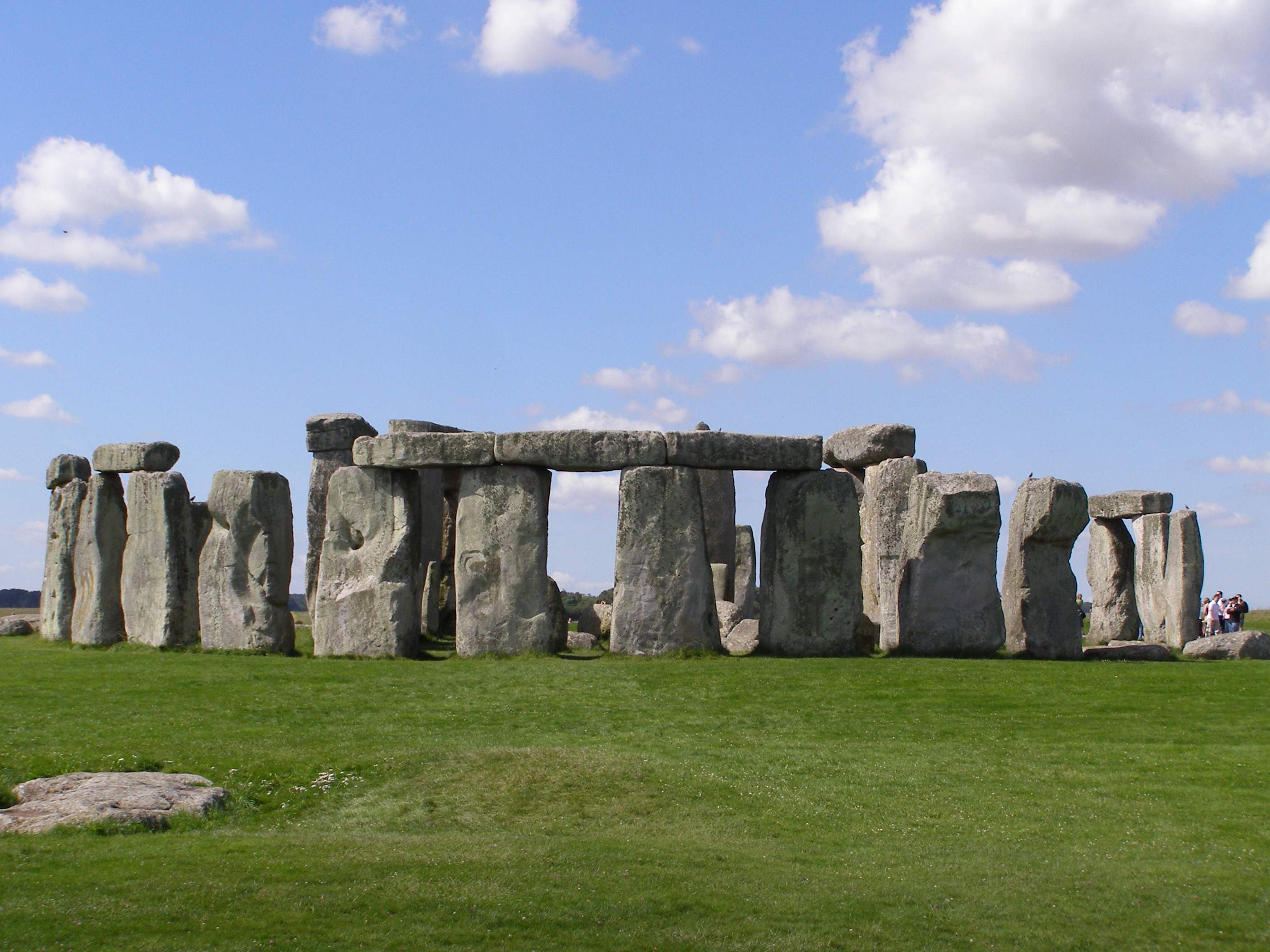
The “parchmarks” were discovered by gardener Tim Daw whose job was to water the grass around the stones during the driest weeks of the summer. In July of last year, gardener Daw had to use a water hose that did not reach the south-west quadrant of Stonehenge.
Coincidentally (or was it?) this was also the part where there was a gap in the otherwise Stonehenge circle. Daw recalls the moment when he noticed something that apparently had eluded historians so far:
“I was standing on the public path looking at the grass near the stones and thinking that we needed to find a longer hosepipe to get the parched patches to green up. A sudden light-bulb moment in my head, and I remembered that the marks were where archaeologists had looked without success for signs that there had been stone holes, and that parch marks can signify them. I called my colleague over and he saw them and realised their possible significance as well. Not being archaeologists we called in the professionals to evaluate them. I am still amazed and very pleased that simply really looking at something, that tens of thousands of people had unwittingly seen, can reveal secrets that sophisticated machinery can't.”
The Stonehenge mystery solved, or at least one of the mysteries, by a gardener instead of archaeologists is somewhat hard to believe. Wouldn’t historians have taken a closer look at those missing spots during the past decades and maybe even dug up some of the grass which might explain the signs of dry patches? However, archaeologists are apparently stunned by the gardener’s keen observation and admit that they were unable to discover what Tim Daw did by merely looking at the site. In September's issue of the journal Antiquity, British archaeologist Mike Pitts explained the impact that the gardener's discovery has on the scientific community and Stonehenge:
"This is a wonderful piece of serendipitous research, highly productive and promptly published. If anyone remained unconvinced that new, targeted excavation at Stonehenge is needed, surely any doubts must now be dispelled?"

Video. Stonehenge mystery solved


Saturday, May 4, 2013

Gobekli Tepe: The temple that should not exist

by
Gobekli Tepe (trad: round hill - navel) is an archaeological site located about 18 km north-east
from the city of Şanlıurfa in modern Turkey, near to the Syria border, in which was found the oldest example of a stone temple, dating back to 9600 BC and that is undermining all the standard believes about the origins of Human civilization.

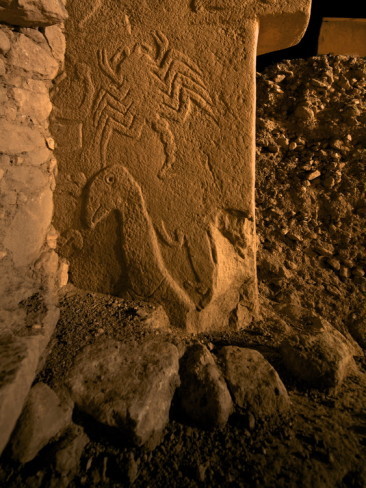
Göbekli Tepe is vaguely reminiscent of Stonehenge but it was built much earlier and not with blocks of stone roughly cutted but with limestone pillars finely sculpted in bas-relief. They are still visible parade of gazelles, snakes, foxes, scorpions, wild boar!

The Complex dates back to seven millennia before the Great Pyramid of Giza, and it is the oldest known example of monumental architecture. Around 8000 BC the site was abandoned deliberately and voluntarily buried with earth brought by man.

Archaeologists continue to dig and discuss its meaning. Göbekli Tepe and other sites in the Middle East are changing our ideas about a turning point in human history: the Neolithic Revolution, when hunter-gatherers were transformed into sedentary farmers.

The site is located on an artificial hill about 15 meters high with a diameter of about 300 m, situated on the highest point of elevation of a elongated shape which dominates the surrounding region, between the Taurus Mountains and the Karaca Dag and valley where the city of Harran. The site used by man would have had an extension from 300 to 500 square meters.

So far, less than a tenth of the site has been excavated. This gives an idea of ​​the awe inspired in the temple to the pilgrims who gathered here 7,000 years before the construction of Stonehenge.

Gobekli tepe

The Gobekli Tepe discovery

Gobekli Tepe was first identified in 1963 by a turkish-American research group. They noticed several piles consisting of fragments of flint, a sign of human activity in the Stone Age. The site was later rediscovered thirty years later by a local pastor, he noticed some odd shaped stones protruding from the ground.

The news came to the head of the museum of the city of Şanlıurfa, who contacted the ministry, who in turn got in touch with the German Archaeological Institute in Istanbul headquarters.

The excavations were begun in 1995 by a joint cooperation between the Museum of Şanlıurfa and the German Archaeological Institute under the direction of Klaus Schmidt. The latter was working in the previous year some archaeological sites in the region. In 2006 the excavations went to German universities of Heidelberg and Karlsruhe.

The excavations brought to light a monumental megalithic sanctuary, consisting of an artificial hill bordered by stone walls rough dry. They were also found four circular enclosures, bordered by huge limestone pillars weighing over 10 tons each, probably plucked with the use of stone tools. According to the Director of the archeological site, the stones pricked up and arranged in a circle symbolize an assembly of men.

The more interesting discovery concerns about 40 stones disposed to form a T high as five feet. The limestone blocks, weighing five tons, were brought here from a nearby quarry even if the wheel or domesticated beasts of burden were not yet introduced.

Most of them are engraved and they show the different types of animals (snakes, ducks, cranes, bulls, foxes, lions, boars, cows, scorpions, ants). Some recordings were voluntarily canceled, perhaps to prepare the stone to receive new ones. There are also decorative elements such as patterns of dots and geometric patterns.

Geomagnetic surveys have indicated the presence of other stones, almost 250 still buried in the ground. Another T-shape stone, extracted only half the quarry, was found about 1 km far from the site. It has a length of about 9 m and was probably intended for the sanctuary but from some reason was abandoned.

There are also some isolated sculptures, in clay, very ruined by time, which probably represent a boar or a fox. Comparisons can be made with statues of the same type found in the sites of Nevali choirs and Nahal Hemar.

The sculptors had to do their work directly on the plateau of the sanctuary, where they were also found stones unfinished and bowl-shaped cavity in the rock clay, a technique already used during the Epipaleolithic to get clay for sculptures or the clay binder used in the masonry.

In the rock there are also phallic representations, maybe go back to later periods, finding comparisons in Sumerian and Mesopotamian cultures (sites of Byblos, Nemrik, Helwan and Aswad).

Until now, 45 of these stones have been dug, but there are indications that there is much to discover. Geomagnetic surveys imply that there are hundreds more standing stones, just waiting to be brought to light. Gobekli Tepe would have been an extraordinary site. A kind of Turkish Stonehenge.

Several factors make of Gobekli Tepe archeology an isolated and unique case.
The first is its age. Radiocarbon dating shows that the complex is at least 12,000 years ago, perhaps even 13,000 years old.

This means that it was built around 10,000 BC. Gobekli Tepe is thus the oldest complex site constructed by Man in the world. It is so old that it precede the time when it is believed Man become sedentary. Gobekli comes from a part of human history that is unimaginably distant, deep past of hunter-gatherers.

How did cavemen build something so ambitious? The archaeologist Klaus Schmidt, thinks that bands of hunters would have gathered sporadically at the site, during the decades of construction, they lived in tents made of animal skin and kill the local game for food. The many flint arrowheads found around Gobekli support this thesis, but also support the dating of the site.

This revelation, that Stone Age hunter-gatherers could have built something like Gobekli, radically changes our view of the world, because it shows that the life of the ancient hunter-gatherers in this region of Turkey, was far more advanced than we ever conceived. It is as if Gods came down from heaven  and Gobekli had been built with their own hands.

Gobekli Tepe as a Constellation representation

The particular arrangement of the complex of Gobekli Tepe is also the arrangement of the main stars of the constellation of the Pleiades (also known as the Seven Sisters, called by the ancient Romans Vergilie) that count different stars visible at naked eye in the constellation of Taurus.

A few years ago, archaeologists found at Cayonu a pile of human skulls. They were found under a slab altar, dyed with human blood. No one is sure, but this may be the first evidence of human sacrifice: one of the most inexplicable human behavior, which could have developed only in the face of a terrible societal stress.

Experts are debating the evidence of Cayonu. But what no one denies is that human sacrifice took place in this region, including Palestine, Israel and Canaan. Archaeological evidence indicates that the victims were killed in huge death pits, children were buried alive in jars, others were burned in large jars of bronze.

These are almost incomprehensible acts, unless you think that the people had learned to have fear of Gods, because they had been driven out of paradise. So he tried to propitiate the wrath of heaven. This savagery may, indeed, be the key to a final solution, baffling mystery. The amazing stone friezes of Gobekli Tepe are preserved intact for a bizarre reason.

Long ago, the site was deliberately and systematically buried with a colossal work together with all its wonderful stone carvings. Around 8000 BC, the creators of Gobekli buried their realization and their glorious temple under thousands of tons of earth, creating the artificial hills on which the Kurdish shepherd walked in 1994. The reason that led the ancients to bury forever the temple of Gobekli Tepe remains a mystery.

Sunday, March 18, 2012

Strange structures on the Moon. NASA confirms indirectly

by
NASA has confirmed, but only accidentally, what many people have suspected for long time, namely Moon's Ruins of mysterious civilizations. In the picture below, taken at the NASA Ames Research Center, if we zoom the picture on the table, we can clearly distinguish two structures on the Moon that are not necessarily natural. 

We can clearly see a square shaped building, and on the right a triangular structure or maybe a bridge on the Moon. The Man in the foreground is Anthony Colaprete and works at NASA www.nasa.gov/centers/ames/research/2007/colaprete.html.  Could those structures on the Moon be made by civilizations? It 'a very intriguing mystery. Below there is also a Video of the strange structures on the Moon.


Video of the Strange Structures on The Moon visible on a NASA picture

Saturday, December 3, 2011

The Mysterious Origins of Man

by
A very beautiful film on the Mysterious origins of the civilization and one of our greatest mysteries: Man's origins. The film sounds as a scientific investigation about some evidence that the academic community has quietly ignored on the origins of Man. 

Top Ad 728x90